Petroxestes pera Wilson et Palmer, 1988
Synonymy
| 2019 | Petroxestes pera Wilson & Palmer, 1988 | Vinn, Wilson & Toom | 453-457 | 3 | Vinn et al., 2019c |
| 2004 | Petroxestes pera | Tapanila, Copper & Edinger | 296 | 3 | Tapanila et al., 2004 |
| 2003 | Petroxestes pera Wilson & Palmer | Pickerill et al. | | | Pickerill et al., 2003 |
| 2003 | Petroxestes pera | Taylor & Wilson | | 3A | Taylor & Wilson, 2003 |
| 2002 | Petroxestes pera | Tapanila & Copper | 18 | 3 | Tapanila & Copper, 2002 |
| 1988 | Petroxestes pera n. isp. | Wilson & Palmer | 307 | 1,2 | Wilson & Palmer, 1988 |
Type specimens
Descriptions and remarks
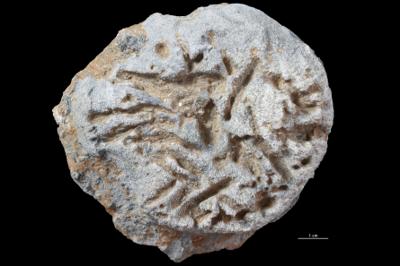
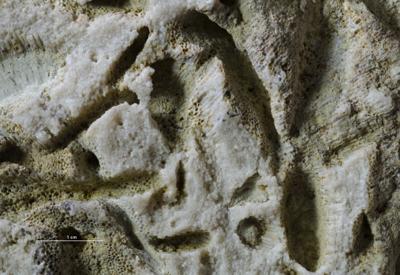
Ecological remark. Petroxestes pera is found both on the upper surfaces and undersides of cobbles and hardgrounds, but usually only on the undersides of biogenic substrates.
Diagnosis: Shallow to deep, elongate borings in lithic substrates; rounded ends and parallel, slightly convex, or slightly concave sides in plan view; rounded bottoms in longitudinal and transverse section; sides parallel or slightly divergent down wards in deeper specimens; length up to 30 mm; several times as long as wide.
Occurrences
Specimens with images (4)


Browse Categories of Architectural Design (CADs):
Borings with elliptical to sub-rectangular cross sections | Branched tubular borings | Camerate boxwork borings | Camerate network borings | Circular holes and pit-shaped borings | Clavate-shaped borings | Cylindrical vertical to oblique borings | Dendritic and rosetted borings | Elongate or branched attachment bioerosion traces | Fracture-shaped bioerosion traces | Globular to spherical borings | Groove bioerosion traces | Multiple attachment bioerosion traces | Non-camerate boxwork borings | Non-camerate network borings | Pouch borings | Radial borings | Single circular to tear-shaped attachment bioerosion traces | Spiral borings | Trackways and scratch imprints | U-shaped borings | Winding borings |