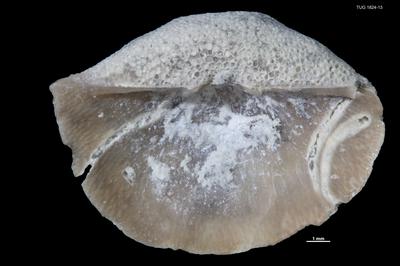
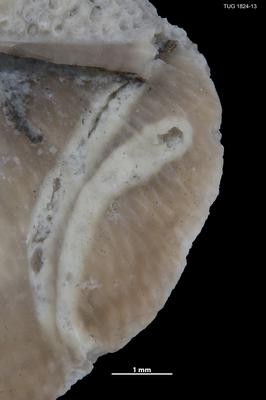
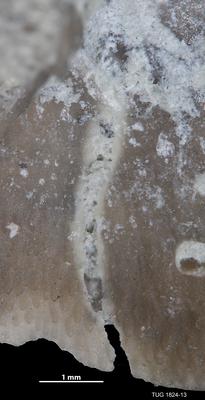
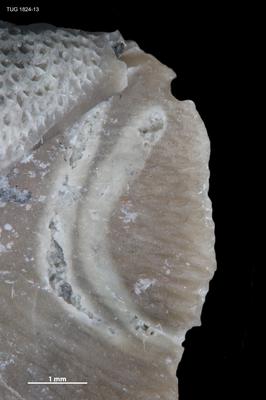
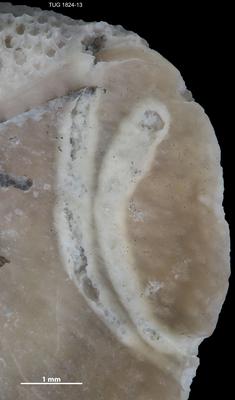
| 2023 | Palaeosabella prisca | Vinn, Ernast, Wilson, Tinn, Isakar & Toom | | 2.2 | Vinn et al., 2023c |
| 2021 | Palaeosabella prisca (McCoy, 1855) | Villas, Mayoral, Santos, Colmenar & Gutiérrez-Marco, | | 1A-F; 2; 3A-F; 4C,D | Villas et al., 2021 |
| 2016 | Vermiforichnus clarkei Cameron, 1969 | Hanken, Uchman, Nielsen, Olaussen, Eggebø & Steinsland | 208 | 12C-E | Hanken et al., 2016 |
| 2007 | Trypanites fimbriatus (Stephenson, 1952) | Blissett & Pickerill | 94 | 5:2 | Blissett & Pickerill, 2007 |
| 2005 | Trypanites aff. fimbriatus | Vinn | 4, 5 | | Vinn, 2005a |
| 1987 | Trypanites fimbriatus (Stephenson, 1952) | Bromley & D'Alessandro | 405 | 42:5 | Bromley & D'Alessandro, 1987 |
| 1987 | Specus fimbriatus Stephenson 1952 | Vogel, Golubić & Brett | 279 | 11 | Vogel et al., 1987 |
| 1975 | Ostreoblabe perforans | Häntzschel | W131 | 80,5 | Häntzschel, 1975 |
| 1965 | Ostreoblabe perforans n. g. n. sp. | Voigt | 196 | 25:1-4; 26;1, 3, 4 | Voigt, 1965 |
| 1965 | Palaeosabella prisca Clakre | Voigt | 199 | text fig. 1 | Voigt, 1965 |
| 1965 | Ostreoblabe perforans n. g. n. sp. | Voigt | 169 | 25:1-4; 26:1, 3, 4 | Voigt, 1965 |
| 1953 | Clionolithes implicatus n. sp. | Hyde | 214 | 1:1-4 | Hyde, 1953 |
| 1952 | Specus fimbriatus | Stephenson | | | Stephenson & Stenzel, 1952 |
| 1921 | Palaeosabella prisca | Clarke | 91 | 77-83 | Clarke, 1921 |
| 1908 | Gitonia sipho | Clarke | | 1:1, 4 | Clarke, 1908 |
| 1855 | Vioa prisca | McCoy | 260 | 1B:1,1a | McCoy, 1855 |