Ropalonaria Ulrich, 1879
Ropalonaria needs revision/re-evaluation according to Wisshak et al., 2019a
| ID | 13866 |
|---|---|
| Fossil group | Bioerosional trace fossils |
| CAD | Camerate network borings |
| Type | Macroboring |
| Substrate | Calcareous substrate |
| Taxon | Ropalonaria |
| Author | Ulrich, 1879 |
| Reference | Ulrich, 1879 |
| Parent taxon | Podichnidae |
| Is valid | Yes |
| FAD | Katian |
| LAD | Aptian |
Includes:
Synonymy
| Year | Synonym | Author | Pages | Figs | Reference |
|---|---|---|---|---|---|
| 2019 | Ropalonaria Ulrich, 1879 | Wisshak, Knaust & Bertling | 3 | Wisshak et al., 2019a | |
| 2006 | Ropalonaria Ulrich, 1879 | Wilson & Palmer | 111 | Wilson & Palmer, 2006 | |
| 2003 | Ropalonaria Ulrich, 1879 | Taylor & Wilson | 11 | Taylor & Wilson, 2003 | |
| 1995 | Ropalonaria Ulrich, 1879 | Bertling | 359 | Bertling, 1995 | |
| 1978 | Ropalonaria Ulrich, 1879 | Pohowsky | 46 | Pohowsky, 1978 | |
| 1944 | non Ropalonaria, Ulrich | Condra & Elias | 545 | Condra & Elias, 1944 | |
| 1904 | Rhopalonaria, Ulrich | Ulrich & Bassler | 267 | Ulrich & Bassler, 1904a | |
| 1884 | Rhopalonaria | Vine | 84 | 4 | Vine, 1884b |
| 1879 | Ropalonaria | Ulrich | 26 | Ulrich, 1879 |
Descriptions and remarks
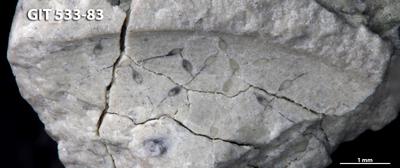
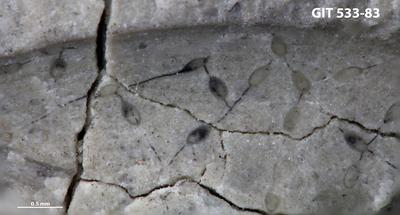
Among the partly corresponding bryozoan zootaxa, many were described solely on the basis of their borings, and thus should be considered ichnotaxa rather than zootaxa.This concerns for instance Spathipora Fischer, 1866, Terebripora d'Orbigny, 1847, Foraripora Voigt and Soule,1973, Ropalonaria Ulrich, 1879, and Orbignyopora Pohowsky, 1978, to name just a few.
Remark: Ramifying tunnels with periodic expansions and openings to the surface putatively made by ctenostome bryozoans. Various other ctenostome borings have been named, some as trace fossils but others as body fossils, including Iramena, Orbignyopora, Penetrantia, Pennatichnus, and Pinaceocladichnus. The total range of ctenostome borings is Ordovician– Recent.
Occurrences
Specimens with images (2)