Trypanites weisei Mägdefrau, 1932
| ID | 13151 |
|---|---|
| Fossil group | Bioerosional trace fossils |
| Taxon | Trypanites weisei |
| Author | Mägdefrau, 1932 |
| Reference | Mägdefrau, 1932 |
| Parent taxon | Trypanites |
| Is valid | Yes |
| FAD | Katian |
Synonymy
| Year | Synonym | Author | Pages | Figs | Reference |
|---|---|---|---|---|---|
| 2023 | Trypanites weisei Mägdefrau, 1932 | Toom, Kuva & Knaust | 108 | 1J-K | Toom et al., 2023a |
| 2023 | Trypanites weisei Mägdefrau, 1932 | Knaust et al. | 4 | 3 | Knaust et al., 2023a |
| 2022 | Trypanites weisei Mägdefrau, 1932 | Matysik, Stachacz, Knaust & Whitehouse | 7, 8 | 7A | Matysik et al., 2022 |
| 2020 | Trypanites weisei Mägdefrau, 1932 | Stachacz & Matysik | 9 | 9E, F; 10C | Stachacz & Matysik, 2020 |
| 2016 | non Trypanites weisei Mägdefrau, 1932 | Hanken, Uchman, Nielsen, Olaussen, Eggebø & Steinsland | 208 | 12A, B | Hanken et al., 2016 |
| 2013 | Trypanites weisei Mägdefrau, 1932 | Taylor et al. | 236 | 15 | Taylor et al., 2013b |
| 2013 | Trypanites weisei Mägdefrau, 1932 | Knaust | 22C | Knaust, 2013a | |
| 2008 | Trypanites weisei Mägdefrau, 1932 | Knaust | 355 | 2A, B, 5A | Knaust, 2008 |
| 2007 | Trypanites weisei Mägdefrau, 1932 | Knaust | 235 | 11D | Knaust, 2007b |
| 2001 | Trypanites weisei Mägdefrau, 1932 | Fodor | 16 | 3:4 | Fodor, 2001 |
| 2000 | non Trypanites weisei Mägdefrau, 1932 | Bundschuh | 42 | 2:9, 10 | Bundschuh, 2000 |
| 1999 | Trypanites weisei Mägdefrau, 1932 | Cole & Palmer | 206 | 5, 7 | Cole & Palmer, 1999 |
| 1998 | Trypanites weisei Mägdefrau | Bertling & Insalaco | 155 | Bertling & Insalaco, 1998 | |
| 1992 | Trypanites weisei Mägdefrau, 1932 | Schmidt | 59-60 | 3:3-4 | Schmidt, 1992 |
| 1989 | Trypanites weisei Mägdefrau, 1932 | Ekdale, Brown & Feibel | 391 | 5 | Ekdale et al., 1989 |
| 1982 | Cylindrocavites cretacea isp. nov. | Ghare | 129 | 1:1 | Ghare, 1982 |
| 1932 | Trypanites weisei | Mägdefrau | 151-153 | 5:1-2 | Mägdefrau, 1932 |
Type specimens
| Type | Number | Repository | Type locality | Loc. | Type horizon | Strat. | Remarks | Reference | ID |
|---|---|---|---|---|---|---|---|---|---|
| lectotype | TLUG 5035-701-262 | Thuringian State Office for the Environment and Geology, Jena, Germany | Gleisberg, west slope | Anisian | Knaust et al., 2023a |
Descriptions and remarks
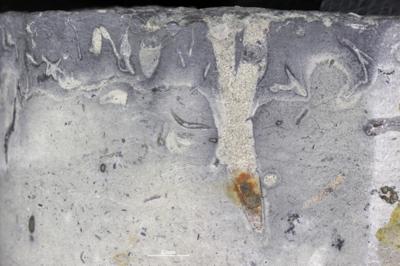
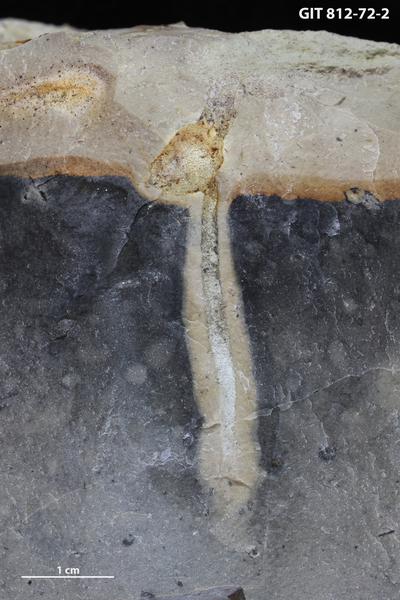
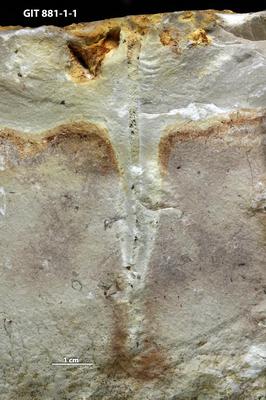
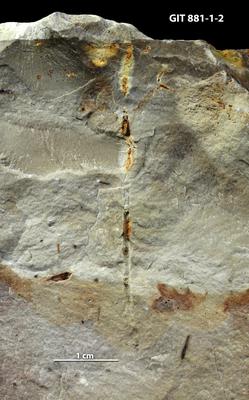
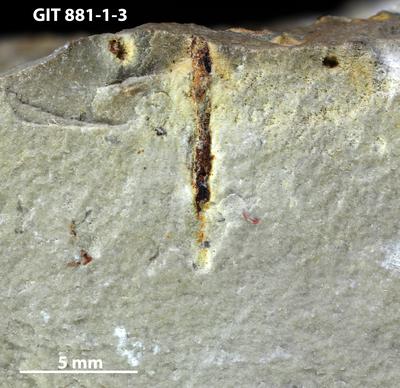
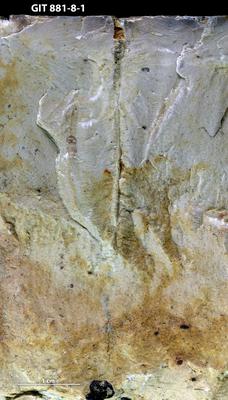
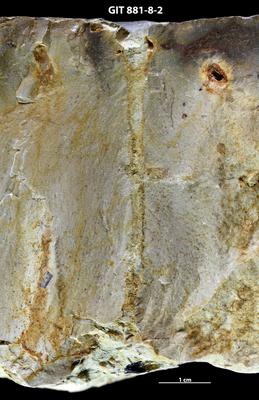
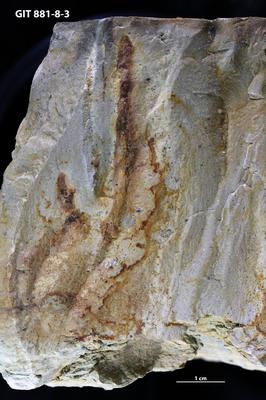
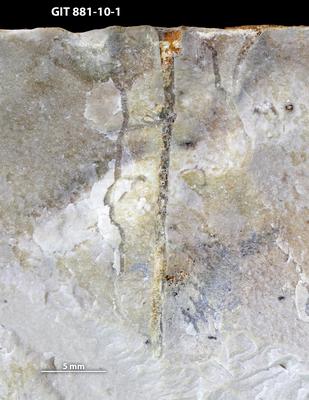
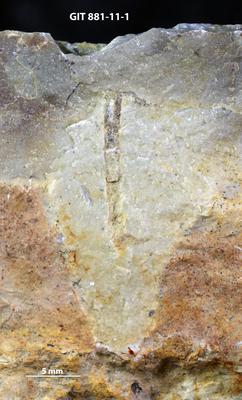
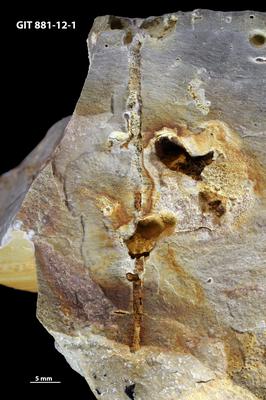
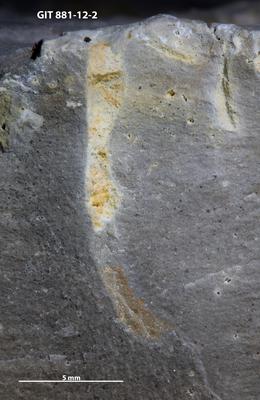
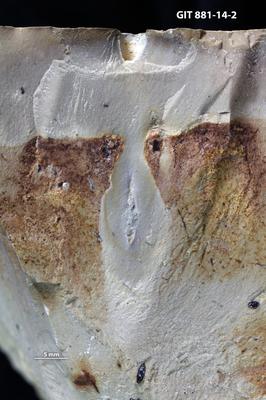
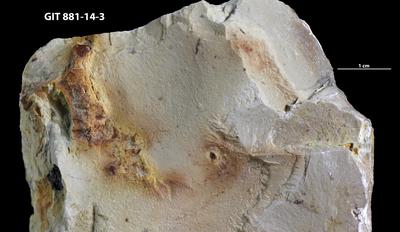
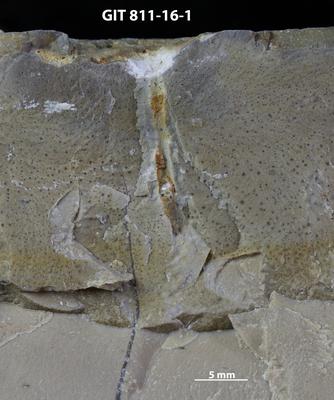
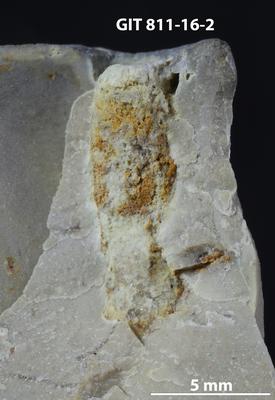
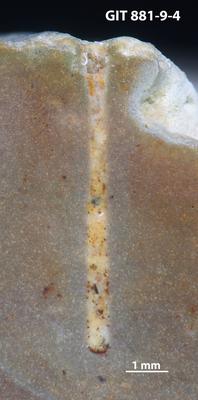
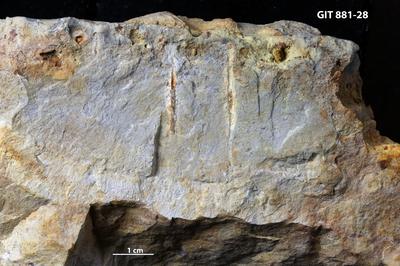
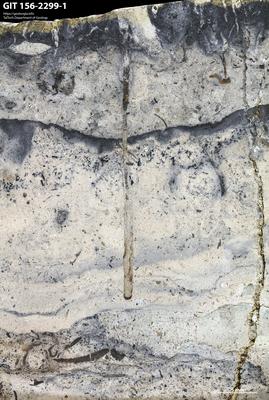
Diagnosis. (Emended after Bromley, 1972, p. 95.) More or less straight and vertical Trypanites penetrating hard substrates.
Description. Essentially straight, simple cylindrical borings. The borings are normally inclined at approximately 30° from vertical. Dimensions vary between individual specimens. Lengths vary between 20-75 μm and width between 1-5 μm.
Remarks. In the redefinition of the ichnogenus Trypanites, Bromley (1972) included dimensions as a diagnostic feature; this is considered inappropriate (see Pickerill, 1994; Bertling et al., 2006) and, as such, is excluded from the diagnoses of both T. solitarius and T. weisei, hence the emendations.
Diagnosis. Simple, vertical, more or less straight borings with a single opening to surface; circular in cross section and isodiametric throughout length.
Description. Borings narrow, elongate and circular to subcircular in transverse section; in longitudinal section borings parallel to subparallel sided (Figures 1, 2) and generally taper towards base (Figure 2.1); apertural diameters average 1.03 mm but some flare (Figure 3.1). Most borings approximately straight (Figures 1, 2) or gently curved at an angle rarely exceeding 150° (Figures 1, 2.1); if curved, a single inflection is characteristic, commonly near distal end (Figure 2.1); borings are up to 19.83 mm long with a mean observed length of about 4mm (Table 1), latter figure should be treated with caution since it represents length of borings visible in thin sections; such lengths not true because thin section only gives random slices through curved and variably-oriented borings; walls of borings unlined and smooth; although no true branching occurs, interpenetrations common (Figures 1, 2) resulting from different stages of boring discerned in stromatoporoid mounds; orientation of borings highly variable, ranging from vertical to subhorizontal.
Description and discussion. T. weisei from the Bajocian/Dinantian unconformity of the Mendips range in diameter from 0.7-2.3mm (n=442) and display a normal distribution, interpreted as natural intraspecific variation, within this range. They have an average diameter of 1.4mm. Lengths are difficult to determine, as short individuals are merely the ends of borings from early colonization phases that have been truncated by erosion. However, they extend a maximum of 130 mm into the Carboniferous Limestone.
Measurements of the type material of T. weisei have recently been made by Dr M. Bertling. Mean diameter is 0.92 mm and maximum diameter is 2.0 mm. Mean length is 16.6mm (range 3.0-54.0mm). We do not consider that the Mendip material is sufficiently different to be distinguishable from T. weisei.
Occurrences
Specimens with images (19)