Trypanites fimbriatus (Stephenson, 1952)
| ID | 11128 |
|---|---|
| Fossil group | Bioerosional trace fossils |
| Taxon | Trypanites fimbriatus |
| Author | (Stephenson, 1952) |
| Reference | Stephenson & Stenzel, 1952 |
| Parent taxon | Trypanites |
| Is valid | No |
Synonymy
| Year | Synonym | Author | Pages | Figs | Reference |
|---|---|---|---|---|---|
| 2007 | Trypanites fimbriatus (Stephenson, 1952) | Blissett & Pickerill | 94 | 5:2 | Blissett & Pickerill, 2007 |
| 1987 | Specus fimbriatus Stephenson 1952 | Vogel, Golubić & Brett | 279 | 11 | Vogel et al., 1987 |
| 1987 | Trypanites fimbriatus (Stephenson, 1952) | Bromley & DAlessandro | 405 | 42:5 | Bromley & D'Alessandro, 1987 |
| 1952 | Specus fimbriatus Stephenson, n. sp. | Stephenson | 51 | 8:4, 6 | Stephenson & Stenzel, 1952 |
Descriptions and remarks
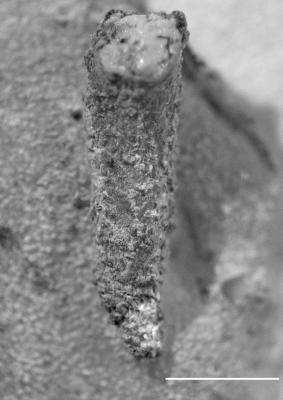
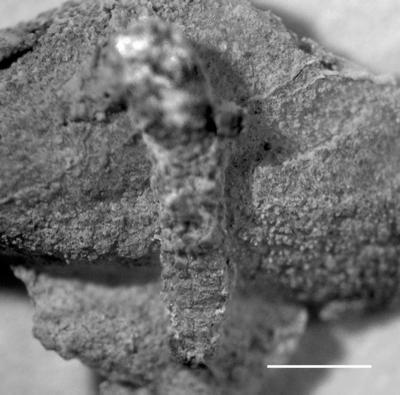
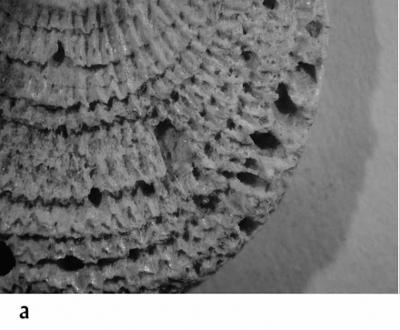
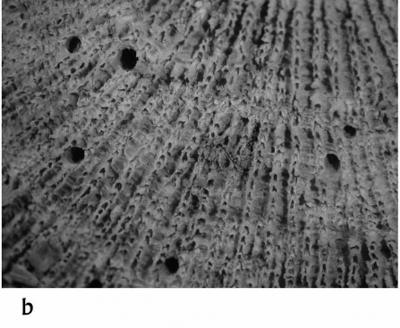
Diagnosis– Single, slightly club-shaped borings having the distal portion a little swollen; axes are straight or gently curved, generally perpendicular to the surface from which the borings originate, but in thin substrates they are forced to run parallel to it. They neither cross each other nor interpenetrate, but show avoidance growth strategies.
Description– Single, slightly curved, club-shaped, unbranched borings each parallel to the substrate surfaces. Lengths average 2·5 mm. The distal portions are swollen and taper to form semicircular terminations. The thicknesses of the borings are consistent and average 520 μm proximally; the diameter of each neck is abruptly reduced to an average diameter of 200 μm.
he casts of borings here described are small clubshaped forms having an observed maximum length of about 8 mm and ranging in diameter from about 0.2 mm at the small end to 0.75 mm at the large end. The larger end is rounded to a subhemispheric profile. The casts have been observed on the internal molds of two bivalve species, Breviarca (Sanoarca) grandis and Ursirivus fanninensis, and on the external mold of one gastropod. At each of the two localities at which the species was found on the internal molds of bivalve shells one specimen of B. (S.) grandis exhibits the casts of the borings; on each of these shells a colony of young sponges was distributed along the margin of the shell and bored inward in the fringing manner shown in the illustrations. That the organism did not always enter the shell at the margin is shown by the internal mold of a right valve of Ursirivus famninensis, on which a cluster of the casts is present on the most inflated part of the mold. The casts are circular in cross section and more or less crooked and irregular in trend; the surface of each cast is smooth. In the holotype most of the casts are covered with a thin film of secondary crystalline calcite except in a few small areas from which the calcite has been accidentally broken away, exposing the smooth surface beneath.
Occurrences
Specimens with images (7)