Oichnus Bromley, 1981
| ID | 13353 |
|---|---|
| Fossil group | Bioerosional trace fossils |
| CAD | Circular holes and pit-shaped borings |
| Type | Predation |
| Substrate | Calcareous substrate |
| Taxon | Oichnus |
| Author | Bromley, 1981 |
| Reference | Bromley, 1981a |
| Parent taxon | Oichnidae |
| Is valid | Yes |
| FAD | Ediacaran |
| LAD | Recent |
Includes:
Synonymy
| Year | Synonym | Author | Pages | Figs | Reference |
|---|---|---|---|---|---|
| 2017 | non Tremichnus Brett | Donovan & Pickerill | 828 | Donovan & Pickerill, 2017 | |
| 2015 | Oichnus Bromley, 1981 | Wisshak, Kroh, Bertling, Knaust, Nielsen, Jagt, Neumann & Nielsen | 448 | Wisshak et al., 2015 | |
| 2015 | Oichnus Bromley, 1981 | Kong, Lee & Lee | 333 | Kong et al., 2015 | |
| 2011 | Oichnus Bromley, 1981 | Breton | 32-33 | Breton, 2011 | |
| 2007 | Oichnus Bromley, 1981 | Blissett & Pickerill | 88 | Blissett & Pickerill, 2007 | |
| 2007 | Fossichnus Nielsen, Nielsen & Bromley, 2003 | Blissett & Pickerill | 86 | Blissett & Pickerill, 2007 | |
| 2006 | Oichnus Bromley, 1981 | Taddei Ruggiero, Buono & Raia | 178 | Taddei Ruggiero et al., 2006 | |
| 2004 | Oichnus Bromley, 1981 | Blissett & Pickerill | 183 | Blissett & Pickerill, 2004a | |
| 2003 | Oichnus Bromley, 1981 | Donovan & Jagt | 69 | Donovan & Jagt, 2002 | |
| 2003 | Fossichnus n. igen. | Nielsen, Nielsen & Bromley | 3-6 | Nielsen, K. S. S. et al., 2003 | |
| 2001 | Oichnus Bromley, 1981 | Nielsen & Nielsen | 102 | Nielsen, , K. S. S. & Nielsen, J. K., 2001 | |
| 1993 | Oichnus Bromley, 1981 | Bromley | 170 | Bromley, 1993a | |
| 1987 | Oichnus Bromley, 1981 | Mayoral | 50 | Mayoral, 1987a | |
| 1984 | Oichnus Bromley, 1981 | Pickerill et al. | 480 | Pickerill et al., 1984a | |
| 1981 | ichnogenus Oichnis nov. | Bromley | 60 | Bromley, 1981a |
Descriptions and remarks
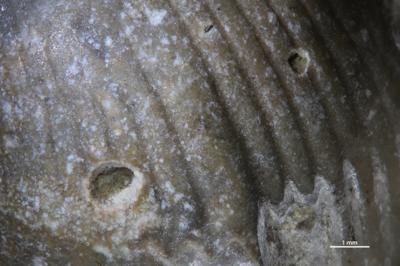
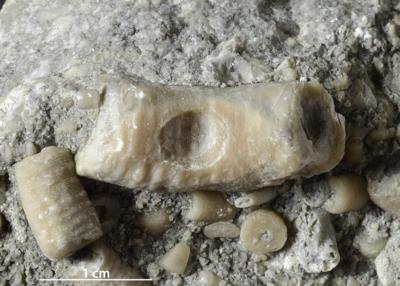
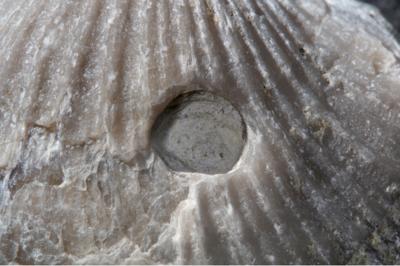
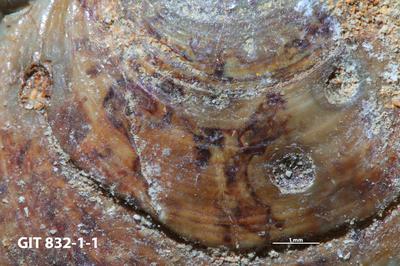
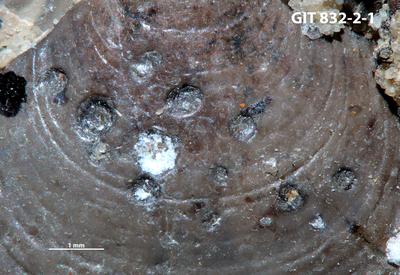
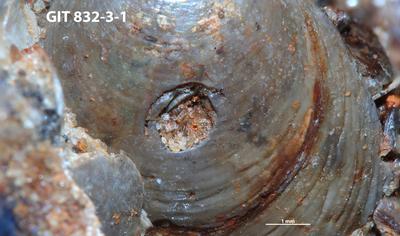
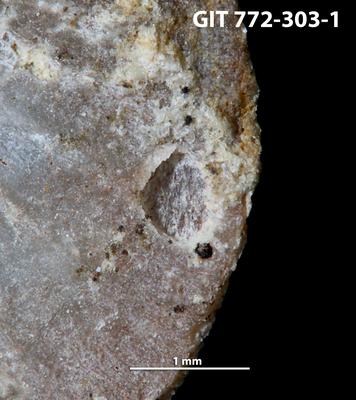
Circular to subcircular holes of biogenic origin bored into hard substrates. The hole may pass right through the substrate as a penetration, where the substrate is a thin shell; or end within the substrate as a shallow to deep depression or short, subcylindrical pit.
Circular to subcircular holes of biogenic origin bored into hard substrates. The hole may pass right through the substrate as a penetration, where the substrate is a thin shell; or end within the substrate as a shallow to deep depression or short, subcylindrical pit.
Tracemaker: They were probably produced by Muricidae and Marginellidae (gastropods) and octopod cephalopods, respectively.
Ethology. Pit-shaped specimens of O. simplex and O. paraboloides have been interpreted as attachment scars (see Franzén, 1974; Brett, 1978, 1985) and may be categorized as domichnia. At least some specimens, especially those of O. paraboloides, were probably produced by potential predators and can be considered as "unfinished' praedichnia. Moreover many different species of benthic foraminiferans are known to be bioeroders (Vénec-Peyré, 1996) and very little knowledge exists as to the reasons for this behavior. At least some specimens of pit-shaped Oichnus may have been produced by sessile host-selective epibionts, probably parasites or commensal suspension-feeding animals of unknown affinities (Brett, 1978,1985).
Unbranced, circular.
Occurrences
Specimens with images (7)